Explore red light therapy for ED, including how it may affect blood flow, potential benefits, safety concerns, limitations, and current research evidence.
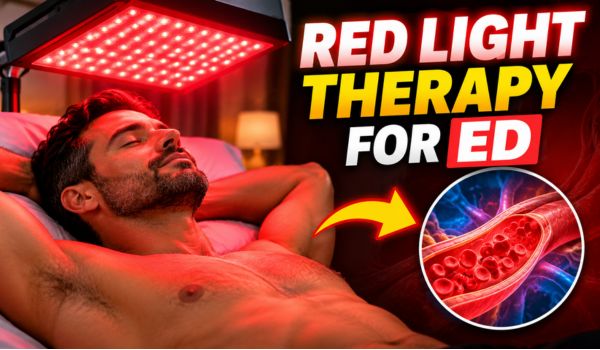

Erectile dysfunction (ED) can have many possible causes, from reduced blood flow and metabolic health problems to medication side effects, hormonal issues, stress, and performance anxiety. Because the condition is so common, interest continues to grow in non-drug approaches that may support erectile function.
Quick Answer: Red and near-infrared light therapy may have biological effects that could theoretically support erectile health, including effects on cellular energy and vascular function. However, there is not yet enough high-quality clinical evidence to conclude that red light therapy reliably treats erectile dysfunction. Men experiencing persistent ED should first discuss the problem with a qualified healthcare professional.
What Is Red Light Therapy?
Red light therapy is a form of photobiomodulation (PBM). Instead of using ultraviolet radiation that can damage skin, photobiomodulation generally uses red or near-infrared wavelengths delivered at relatively low energy levels.
Depending on the device and application, wavelengths may fall roughly within the 600–1,000 nanometer range. Red wavelengths primarily interact with more superficial tissues, while near-infrared light can penetrate somewhat deeper.
Photobiomodulation has been investigated for a wide range of applications, including wound healing, inflammation, musculoskeletal recovery, dermatologic conditions, and pain. Researchers are also exploring whether its effects on blood vessels, oxidative stress, and cellular metabolism could have applications in male reproductive and sexual health.
How Could Red Light Therapy Affect Erectile Function?
An erection is largely a vascular event. Sexual stimulation triggers nerve signals that promote relaxation of smooth muscle and increased blood flow into erectile tissue. When blood enters the corpora cavernosa and is temporarily trapped there, the penis becomes firm.
This means anything that significantly affects vascular health, nerve signaling, hormones, or psychological arousal can potentially affect erectile function.
Researchers interested in red light therapy for ED are primarily investigating whether photobiomodulation could influence some of the biological systems involved in this process.
1. Cellular Energy Production
One proposed mechanism of photobiomodulation involves mitochondria—the structures inside cells responsible for producing much of the body’s usable cellular energy.
Red and near-infrared light may interact with mitochondrial components such as cytochrome c oxidase. This interaction may influence adenosine triphosphate (ATP) production and cellular signaling.
Better cellular energy metabolism does not automatically translate into stronger erections, however. It simply provides one biological reason researchers are interested in studying photobiomodulation in vascular and reproductive tissues.
2. Nitric Oxide and Blood Vessel Function
Nitric oxide plays a major role in erections. It helps relax smooth muscle in penile blood vessels, allowing more blood to enter erectile tissue.
Laboratory research suggests photobiomodulation may influence nitric oxide-related signaling under certain conditions. This has created interest in whether light therapy could eventually support vascular function in men with some forms of ED.
Importantly, a plausible mechanism is not the same thing as proven clinical effectiveness. Large, controlled human trials are needed before we can conclude how meaningful this effect is for ED.
3. Oxidative Stress
Oxidative stress occurs when reactive molecules overwhelm the body’s antioxidant defenses. Excessive oxidative stress can negatively affect endothelial cells—the cells lining blood vessels—and may contribute to vascular dysfunction.
Photobiomodulation has demonstrated antioxidant and anti-inflammatory effects in various experimental settings. Researchers are therefore investigating whether these properties might also benefit tissues involved in erectile function.
4. Tissue Recovery
Researchers have also investigated red light therapy for its potential role in tissue repair and regeneration. This raises additional questions about whether PBM might eventually have applications in men whose erectile difficulties involve vascular or tissue damage.
👉 Thinking About Red Light Therapy for ED? Read This Before You Try It
Red Light Therapy for ED: Potential Benefits vs. Current Evidence
| Potential Effect | Why It May Matter for ED | Current Perspective |
|---|---|---|
| Cellular energy | May influence mitochondrial ATP production | Biologically plausible but not proof of ED treatment |
| Nitric oxide signaling | Nitric oxide is important for penile blood vessel relaxation | Promising mechanism requiring stronger clinical evidence |
| Circulation | Adequate penile blood flow is necessary for erections | Potential benefit remains under investigation |
| Oxidative stress | Oxidative damage can contribute to endothelial dysfunction | Supported by broader PBM research, but ED-specific evidence is limited |
| Tissue recovery | Healthy vascular and erectile tissues support normal function | Experimental application |
What Does the Research Say About Red Light Therapy for ED?
This is where expectations need to remain realistic. There is substantially more research on photobiomodulation for other medical and rehabilitation applications than there is specifically for erectile dysfunction.
Scientific reviews of low-level laser therapy and male reproductive health describe potentially relevant mechanisms, including effects involving mitochondria, oxidative stress, inflammation, and cellular signaling. Preclinical findings have encouraged researchers to investigate possible applications in erectile and reproductive function.
Small human studies have also begun examining low-level laser or photobiomodulation approaches in populations experiencing erectile problems. Some have reported improvements in erectile-function measurements, but these findings do not yet establish red light therapy as a standard ED treatment.
Studies may differ substantially in the wavelength used, treatment location, light intensity, dosage, session duration, number of treatments, underlying cause of ED, and methods used to measure outcomes. These differences make it difficult to define an evidence-based protocol for consumer red light devices.
Larger randomized, sham-controlled trials with longer follow-up periods are needed to determine which patients—if any—are most likely to benefit.
Is Red Light Therapy an FDA-Approved Treatment for Erectile Dysfunction?
Consumers should be cautious about interpreting marketing claims surrounding wellness devices. A device producing red or near-infrared light should not automatically be assumed to be proven or specifically approved to treat erectile dysfunction.
Regulatory clearance of a particular device for one application does not necessarily mean the device has been shown to treat ED.
Before buying a device because it promises to improve erectile function, discuss the product, intended treatment area, specifications, and available clinical evidence with a healthcare professional.
✓ Pros
- Noninvasive therapy with no needles or surgery needed.
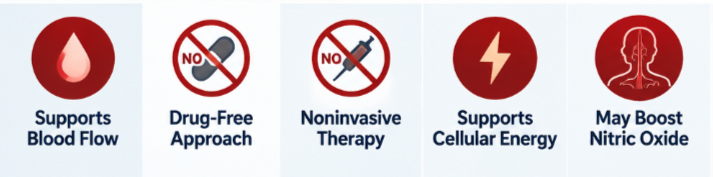
- Drug-free option without taking pills before intimacy.
- May help support healthy circulation and blood flow.
- May support nitric oxide pathways linked to erections.
- Supports mitochondrial activity and cellular energy.
- May help regulate inflammation in body tissues.
- May support healthier oxidative stress responses.
- Convenient option with suitable at-home light devices.
- Requires little to no recovery time after sessions.
- Promising research area for future erectile health care.
✗ Cons
- Limited clinical evidence specifically for treating ED.
- No standard wavelength, dosage, or treatment schedule.
- Results may vary depending on the underlying cause of ED.
Can You Use Red Light Therapy at Home for ED?
Home red light panels, handheld devices, wraps, and other photobiomodulation products are widely available. However, devices vary significantly in wavelength, irradiance, treatment distance, power output, and intended use.
That creates a major problem when discussing home treatment for ED: there is currently no universally established home protocol specifying exactly what wavelength, dose, exposure time, frequency, or treatment location reliably improves erectile dysfunction.
More light is not necessarily better. Photobiomodulation can have dose-dependent effects, so copying a protocol designed for skin, muscles, or another body area may not be appropriate for genital tissue.
👉 Want to Try Red Light Therapy for ED? Read This First
Possible Side Effects and Safety Considerations
Properly administered low-level red light therapy is generally considered noninvasive. Depending on the device and exposure, possible issues can include temporary warmth, redness, skin irritation, discomfort, or eye exposure concerns.
The genital area is particularly sensitive, making correct dosing and device selection important. A product intended for the face, back, or athletic recovery should not automatically be assumed suitable for direct penile exposure.
People taking photosensitizing medications, those with certain skin conditions, or anyone undergoing treatment for a serious medical condition should speak with their healthcare provider before experimenting with photobiomodulation.
Red Light Therapy vs. Established ED Treatments
One reason red light therapy attracts attention is that it is noninvasive and does not require taking medication immediately before sex. But novelty and convenience should not be confused with stronger evidence.
| Treatment | Evidence for ED | Main Consideration |
|---|---|---|
| PDE5 inhibitors | Strong clinical evidence | Not appropriate for everyone; medication interactions matter |
| Vacuum erection devices | Established option | Mechanical device requiring correct use |
| Penile injections | Established option | Requires prescription and instruction |
| Lifestyle changes | Can support erectile and cardiovascular health | Benefits develop gradually |
| Red light therapy | Early/emerging evidence | No established standard ED protocol |
Why Finding the Cause of ED Matters More Than Choosing a Device?
Erectile dysfunction is not a single disease. It is a symptom that can develop for many different reasons.
Diabetes, hypertension, high cholesterol, obesity, smoking, cardiovascular disease, low testosterone, neurological disorders, certain medications, depression, anxiety, relationship difficulties, and previous pelvic surgery can all contribute.
This matters because ED can sometimes be an early indicator of vascular problems elsewhere in the body. Penile arteries are relatively small, meaning impaired vascular function may become noticeable as erection difficulties before other cardiovascular symptoms appear.
For that reason, simply purchasing a red light device without investigating persistent erectile difficulties could delay identification of an underlying health issue.
Who Might Be Interested in Photobiomodulation Research?
As research develops, scientists may determine that certain forms of ED respond differently to photobiomodulation than others.
A therapy designed to influence vascular or cellular function, for example, would not necessarily be expected to resolve erectile difficulties caused primarily by severe hormonal deficiency, psychological distress, medication effects, or advanced nerve damage.
This is another reason future research needs to classify participants according to the underlying cause and severity of their ED rather than treating all erectile dysfunction as one condition.
👉 Before Trying Red Light Therapy for ED, Here’s What You Need to Know
Ways to Support Erectile Health Naturally
While research on red light therapy continues, there are several better-established ways to support cardiovascular and erectile health.
- Exercise regularly, including aerobic and resistance activity.
- Maintain a healthy weight and waist circumference.
- Eat a cardiovascular-friendly diet rich in vegetables, fruits, whole foods, legumes, and healthy fats.
- Avoid smoking and other tobacco products.
- Limit excessive alcohol consumption.
- Manage blood pressure, cholesterol, and blood sugar.
- Prioritize adequate sleep.
- Address chronic stress, anxiety, depression, or performance anxiety.
- Discuss medications that may contribute to ED with your healthcare provider rather than stopping them yourself.
Improving these areas may support erections and benefit cardiovascular health, energy levels, metabolic health, and overall quality of life.
When Should You See a Doctor About ED?
An occasional difficulty getting or maintaining an erection is common and does not necessarily indicate a medical problem. Persistent or progressively worsening ED deserves professional evaluation.
Consider speaking with a healthcare provider if erection difficulties occur regularly, appeared suddenly without an obvious explanation, are accompanied by reduced sexual desire, began after starting a medication, or are causing significant personal or relationship distress.
Medical evaluation can also help identify cardiovascular and metabolic risk factors that may be contributing to the problem.
The Bottom Line: Is Red Light Therapy for ED Worth Considering?
Red light therapy for ED is scientifically interesting, but it remains an emerging area rather than an established treatment. Photobiomodulation can influence cellular processes associated with energy metabolism, oxidative stress, inflammation, and vascular biology, giving researchers reasonable grounds to investigate it further.
What is still missing is strong clinical evidence showing that a specific red or near-infrared light protocol consistently improves erections in men with erectile dysfunction. Researchers also need to establish appropriate wavelengths, doses, treatment locations, frequency, long-term effectiveness, and which types of ED are most likely to respond.
For now, men should be cautious about devices marketed with dramatic claims such as permanently curing ED, dramatically increasing testosterone, or replacing prescription treatment. If you are interested in photobiomodulation, consider discussing it with a clinician as a potential complementary approach rather than abandoning treatments supported by stronger evidence.
Most importantly, persistent erectile dysfunction deserves proper evaluation. Understanding why ED is happening is usually far more valuable than simply choosing the newest device marketed for it.
Frequently Asked Questions
Does red light therapy really work for erectile dysfunction?
There is not currently enough high-quality clinical evidence to say that red light therapy reliably treats erectile dysfunction. Early research and proposed biological mechanisms are interesting, but larger controlled studies are needed.
What color light is best for erectile dysfunction?
Research into photobiomodulation generally focuses on red and near-infrared wavelengths. However, there is no universally accepted wavelength or treatment protocol proven to be best for erectile dysfunction.
Can red light therapy increase testosterone?
Claims that red light therapy reliably increases testosterone in men should be approached cautiously. Animal or laboratory findings cannot automatically be applied to humans, and red light therapy should not replace appropriate testing or medical treatment for clinically low testosterone.
How long does red light therapy take to work for ED?
No established treatment timeline exists because red light therapy is not currently a standardized ED therapy. Be cautious of products guaranteeing stronger erections after a specific number of sessions.
Can red light therapy replace Viagra or Cialis?
Current evidence does not support treating red light therapy as a proven replacement for prescription PDE5 inhibitors such as sildenafil or tadalafil. Make medication decisions with a qualified healthcare provider.
Can ED be a sign of another health problem?
Yes. Erectile dysfunction can be associated with cardiovascular disease, diabetes, high blood pressure, obesity, hormonal abnormalities, medication effects, psychological conditions, and other health problems. Persistent ED should therefore be evaluated rather than treated solely as a sexual-performance issue.
Reference
- PMC – Photobiomodulation: Lasers vs. LEDs
- WebMD – Red Light Therapy
- PubMed – PBM for Erectile Function
- PubMed – Male Infertility and Erectile Dysfunction
.
About the Author