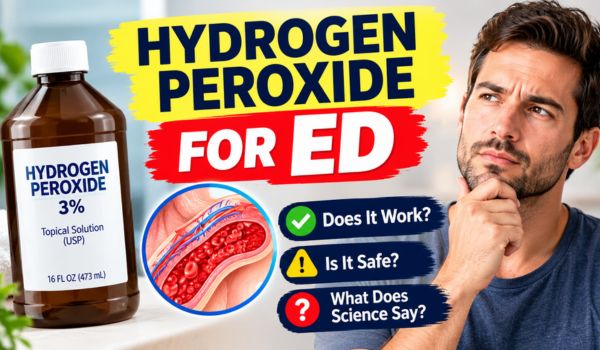
Key Takeaways: Hydrogen Peroxide for ED
- Hydrogen peroxide for ED is an emerging online topic, but it is not a proven treatment for erectile dysfunction.
- Healthy blood flow and cardiovascular health play an important role in maintaining erections.
- There is currently insufficient clinical evidence that hydrogen peroxide improves erectile function.
- Drinking or applying hydrogen peroxide for ED may be unsafe and can cause injury.
- Proven ED approaches include lifestyle changes, counseling, prescription treatments, and other medically recommended options.
- If ED persists, the safest approach is to identify the underlying cause with a healthcare professional.

Can hydrogen peroxide really help with erectile dysfunction? It is a question that has attracted attention online as men increasingly look beyond conventional approaches to sexual wellness.
Erectile dysfunction (ED) is extremely common and can affect men at different stages of life. It may be associated with circulation, stress, medications, hormone changes, metabolic health, relationship factors, or underlying medical conditions.
At the same time, the internet is full of unconventional approaches, including claims about hydrogen peroxide for ED. But an interesting health claim is not the same as a treatment supported by clinical evidence.
Hydrogen peroxide is a reactive chemical compound with legitimate uses in household and industrial settings. However, it is not an established treatment for erectile dysfunction, and there is currently no good clinical evidence showing that drinking, injecting, applying, or otherwise using hydrogen peroxide can safely improve erections.
That doesn’t mean the topic isn’t worth discussing. In fact, understanding why people are interested in hydrogen peroxide for ED and what science actually tells us can help men make smarter decisions about sexual health.
What Is Hydrogen Peroxide?
Hydrogen peroxide is a chemical compound represented by the formula H₂O₂.
It resembles water chemically, but the additional oxygen atom makes it much more reactive. Household hydrogen peroxide commonly contains a relatively dilute concentration, while stronger concentrations are used for industrial and other specialized purposes.
Hydrogen peroxide has several practical applications, including cleaning and disinfecting surfaces. It has also been used in certain products and professional settings where controlled concentrations are appropriate.
However, a substance having legitimate uses does not automatically mean it is appropriate as a medical treatment for another condition.
This distinction is especially important when discussing erectile dysfunction.
Why Are People Searching for Hydrogen Peroxide for ED?
The interest likely stems partly from discussions about oxygen, oxidative processes, circulation, and cellular biology.
Because erections depend heavily on healthy blood flow and vascular function, some alternative-health discussions attempt to connect oxygen-related concepts with sexual performance.
This can sound scientifically plausible at first.
An erection involves a complex interaction between:
- Blood vessels
- Smooth muscle
- Nitric oxide signaling
- Nerve function
- Hormones
- Psychological factors
- Overall cardiovascular health
But this is where it is important to separate biological theory from demonstrated treatment effectiveness.
The fact that oxygen and vascular health are important to erectile function does not establish that hydrogen peroxide can improve erections.
Hydrogen Peroxide and Erectile Dysfunction: What Does the Evidence Say?
This is the most important part of the conversation.
At present, hydrogen peroxide is not an established evidence-based treatment for erectile dysfunction.
Major ED treatment guidance focuses on approaches with clinical evidence, including evaluation of underlying causes and approved treatments such as phosphodiesterase type 5 (PDE5) inhibitors when appropriate.
The American Urological Association’s ED guideline recommends that men with ED be informed about PDE5 inhibitors unless contraindicated.
Hydrogen peroxide is not included as a standard ED therapy.
That means men should be cautious about websites, social media posts, or videos that present hydrogen peroxide as a proven cure.
A useful way to look at the evidence
| Question | What we know |
|---|---|
| Is hydrogen peroxide a chemical with legitimate uses? | Yes |
| Does oxygen biology play a role in erectile function? | Yes |
| Is vascular health important for erections? | Yes |
| Is hydrogen peroxide an FDA-approved ED treatment? | No |
| Is hydrogen peroxide recommended by major ED guidelines? | No |
| Is there strong clinical evidence that it treats ED? | No |
| Should men experiment with ingesting hydrogen peroxide for ED? | No |
This doesn’t make the subject uninteresting. Instead, it highlights an important lesson in sexual health: interesting mechanisms need to be tested in humans before they become treatments.
👉 Thinking About Hydrogen Peroxide for ED? Read This Before You Try It
Why Blood Flow Matters So Much for Erections?
One of the most useful ways to understand ED is to understand what happens during an erection.
Sexual stimulation activates nerve signals that increase the production of signaling molecules such as nitric oxide. This contributes to relaxation of smooth muscle in penile blood vessels.
As the blood vessels relax, blood enters the erectile tissue. The resulting pressure helps produce and maintain an erection.
This is why cardiovascular health and sexual health are closely connected.
Conditions that affect blood vessels—including high blood pressure, diabetes, obesity, smoking, and cardiovascular disease—can also contribute to erectile difficulties.
In some men, ED may even be an early sign that cardiovascular risk factors need attention.
The Positive Side: ED Can Often Be Improved
The good news is that erectile dysfunction is treatable, and identifying the underlying cause can make a significant difference.
Rather than focusing exclusively on one unusual substance, a more productive approach is to look at the major factors that influence erectile function.
1. Improve cardiovascular health
Healthy blood vessels are essential for healthy erections. Regular physical activity, maintaining a healthy weight, controlling blood pressure, and managing cholesterol can all support overall vascular health.
2. Stop smoking
Smoking damages blood vessels and can interfere with normal circulation. Quitting smoking is one of the most meaningful steps a man can take for both cardiovascular and sexual health.
3. Manage diabetes
High blood glucose over time can affect blood vessels and nerves—two systems that are important for erections. Good diabetes management may therefore be an important component of protecting sexual function.
4. Address stress and anxiety
Not every case of ED is primarily physical. Performance anxiety, chronic stress, relationship difficulties, depression, and other psychological factors can interfere with sexual arousal and erection quality.
Addressing these issues can be an important part of treatment.
5. Review medications
Some prescription medications can contribute to sexual difficulties. If ED begins after starting or changing a medication, speak with a healthcare professional rather than stopping the medication independently.
What Are the Established Treatment Options for ED?
Men with persistent erectile difficulties have several options. The appropriate treatment depends on the cause, overall health, medications, and personal circumstances.
| Treatment approach | How it may help |
|---|---|
| Lifestyle changes | Supports cardiovascular and metabolic health |
| PDE5 inhibitors | Improve the body’s erectile response to sexual stimulation |
| Psychological counseling | Can help when anxiety, stress, or relationship factors contribute |
| Vacuum erection devices | Mechanically increase blood flow into erectile tissue |
| Hormone evaluation | May identify testosterone or other hormonal issues when appropriate |
| Other medical treatments | May be considered when first-line approaches aren’t effective |
PDE5 inhibitors—including sildenafil, tadalafil, vardenafil, and avanafil—are among the established medical treatments for ED. The AUA recommends discussing PDE5 inhibitors with appropriate patients unless contraindicated.
A doctor can help determine the right option.
Hydrogen Peroxide for ED vs. Evidence-Based Treatment
This comparison can help put the online claims into perspective.
| Hydrogen Peroxide | Evidence-Based ED Care |
|---|---|
| Widely used as a chemical product | Specifically evaluated for medical use |
| Not an established ED treatment | Multiple established treatment options |
| Limited evidence for improving erections | Supported by clinical research |
| Not recommended by ED guidelines | Included in established clinical approaches |
| Improper exposure can cause injury | Treatments are selected according to individual health needs |
The goal isn’t to dismiss curiosity about alternative health ideas. The goal is to make sure curiosity doesn’t replace safety.
Is It Safe to Drink Hydrogen Peroxide for ED?
This is where extra caution is necessary.
Some online claims recommend consuming diluted or concentrated hydrogen peroxide for various health purposes.
That should not be considered a safe ED treatment.
Poison Control explains that hydrogen peroxide is a reactive chemical and that concentrated products can cause serious internal injury. Ingestion can produce oxygen gas in the stomach, and serious exposures can result in complications including gas embolism.
“Food-grade” hydrogen peroxide is particularly misleading terminology. Despite the name, concentrated food-grade hydrogen peroxide is not a beverage or nutritional supplement. Poison Control specifically warns against using it as an alternative therapy.
Important safety message
Do not drink hydrogen peroxide as a home treatment for erectile dysfunction. It should also not be injected into the penis or applied to genital tissue as an ED treatment.
Genital tissue is sensitive, and chemical irritation or burns can cause additional problems rather than improving sexual function.
👉 Hydrogen Peroxide for Erectile Dysfunction? Here’s What You Need to Know First
What If Someone Has Already Swallowed Hydrogen Peroxide?
Accidental exposure is different from intentional treatment.
If someone has swallowed hydrogen peroxide, the appropriate response depends on the concentration, amount, symptoms, and individual circumstances.
Do not intentionally induce vomiting after a possible poisoning. If someone collapses, has a seizure, has difficulty breathing, or cannot be awakened, emergency medical attention is required.
Natural Ways to Support Better Erectile Health
If your interest in hydrogen peroxide comes from wanting a more natural approach to ED, there are safer areas to focus on.
- Exercise – Regular aerobic activity supports cardiovascular fitness and healthy circulation.
- Better nutrition – A balanced eating pattern emphasizing vegetables, fruits, whole grains, legumes, lean protein, and healthy fats can support metabolic and cardiovascular health.
- Healthy weight – Excess body weight is associated with several conditions that can contribute to ED.
- Quality sleep – Poor sleep and sleep disorders can affect hormones, mood, energy, and sexual function.
- Stress management – Meditation, exercise, counseling, breathing exercises, and adequate downtime may help reduce chronic stress.
These approaches may not produce an overnight change, but they can contribute to the broader foundation of sexual and cardiovascular health.
A Better Question Than “Does Hydrogen Peroxide Cure ED?”
Instead of asking whether one substance can “cure” erectile dysfunction, consider asking:
“Why am I experiencing ED in the first place?”
That question can lead to much more useful answers.
For some men, the cause may be primarily vascular.
For others, diabetes, medication effects, hormonal issues, nerve problems, anxiety, depression, or relationship factors may be involved.
Sometimes more than one factor contributes.
That is why a proper medical evaluation can be valuable—particularly when ED is new, persistent, or worsening.
👉 Considering Hydrogen Peroxide for ED? Discover What the Evidence Really Says
When Should You Talk to a Doctor About ED?
Occasional difficulty getting or maintaining an erection can happen to almost anyone.
However, persistent ED deserves attention.
Consider speaking with a healthcare professional if:
- ED happens repeatedly
- The problem is getting worse
- You have diabetes or high blood pressure
- You have cardiovascular risk factors
- You take medications that may affect sexual function
- You have reduced sexual desire as well as erection problems
- ED is affecting your confidence or relationship
- You are considering an unproven treatment
A medical consultation isn’t simply about getting a prescription.
It can also help identify health conditions that may be contributing to the problem.
The Bottom Line on Hydrogen Peroxide for ED
Interest in hydrogen peroxide for ED reflects a broader trend: people are searching for alternative and natural approaches to sexual wellness.
It is reasonable to ask questions. It is reasonable to investigate emerging ideas.
But there is currently no established clinical evidence that hydrogen peroxide is a safe or effective treatment for erectile dysfunction, and it should not be consumed, injected, or applied to genital tissue as an ED remedy.
The positive news is that men experiencing ED have many safer, evidence-based avenues to explore.
Improving cardiovascular health, addressing lifestyle factors, managing stress, reviewing medications, and discussing established ED treatments with a qualified healthcare professional can provide a much stronger path forward.
Most importantly, erectile dysfunction doesn’t have to be something a man simply accepts.
Understanding the cause is the first step toward finding the right solution.
Frequently Asked Questions
Can hydrogen peroxide cure erectile dysfunction?
There is currently no good clinical evidence that hydrogen peroxide cures or reliably treats erectile dysfunction.
Can I drink hydrogen peroxide for better erections?
No. Drinking hydrogen peroxide as an ED treatment is not recommended. Concentrated hydrogen peroxide can cause serious injury when swallowed.
Does oxygen improve erectile function?
Healthy circulation and oxygen delivery are important to normal tissue function, including erectile function. However, this does not mean that consuming hydrogen peroxide improves erections.
What is a proven treatment for ED?
Established options include lifestyle interventions, counseling when appropriate, and FDA-approved PDE5 inhibitors such as sildenafil, tadalafil, vardenafil, and avanafil for suitable patients.
Can ED be a sign of another health problem?
Yes. ED can be associated with cardiovascular, metabolic, hormonal, neurological, psychological, and medication-related factors. Persistent ED is therefore worth discussing with a healthcare professional.
Sources
- National Institutes of Health NIDDK — Erectile Dysfunction: causes, diagnosis, treatment, and lifestyle approaches.
- WebMD — Safety information regarding hydrogen peroxide ingestion and exposure.
- PubMed — Hydrogen Peroxide Toxicity and safety considerations.
.
About the Author